


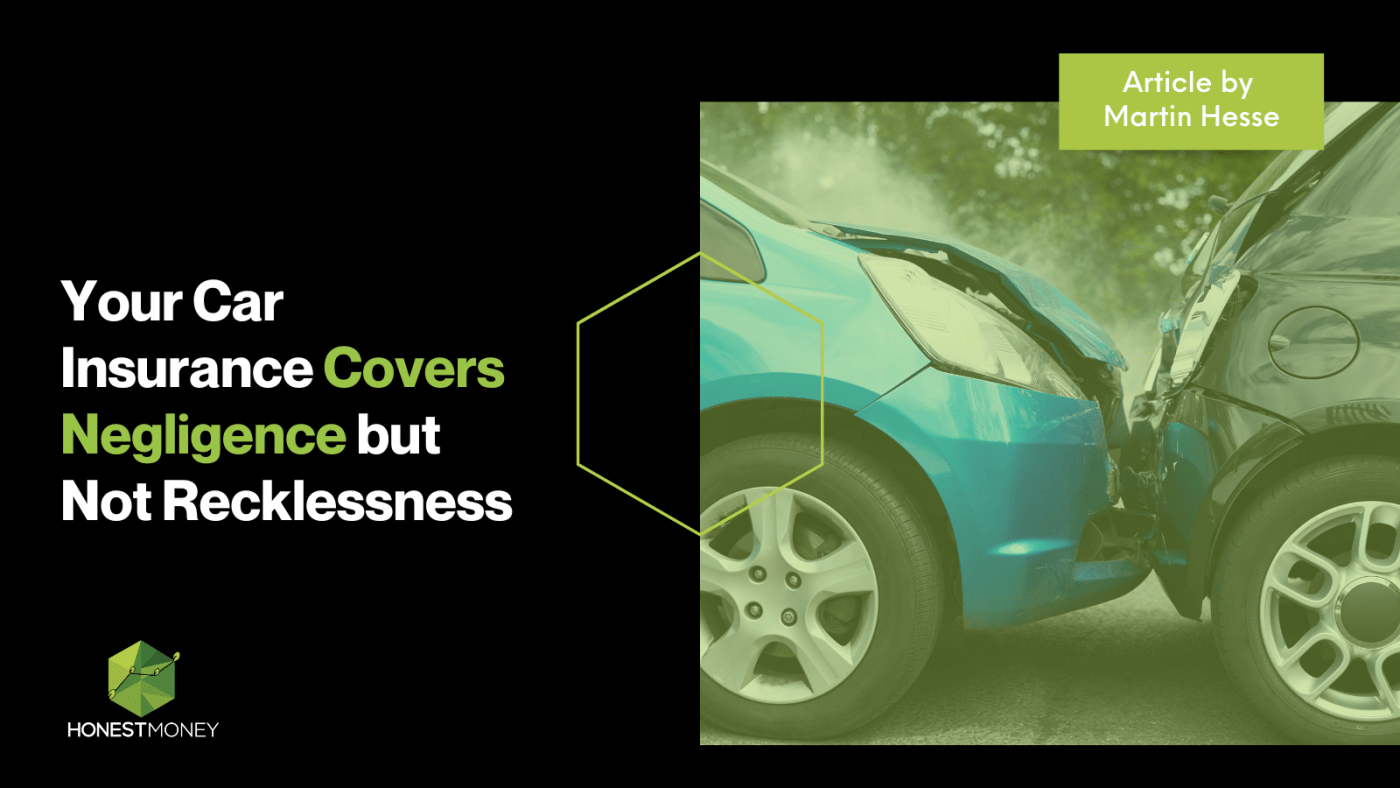
Your vehicle insurance policy will cover you for an accident caused by your negligence, but is unlikely to cover you in the case of reckless driving. It’s important to know the difference between these concepts.
The law distinguishes between “ordinary negligence”, “gross negligence” and “recklessness”.
Ordinary negligence is when you cause an accident through carelessness – in other words, by failing to take the precautions a reasonable person would take in similar circumstances. Examples would be failing to stop at a stop sign or not slowing down enough to navigate a bend.
While you never intended to cause harm, you would still be legally liable for injury to another person or for damage to their property if it is shown that your negligence caused the damage. However, you are insured against this liability by your insurance company, and your only obligation would be to pay the excess (the initial predetermined amount) on a claim.
Gross negligence and recklessness are on another level. While often used interchangeably, they are distinct legal concepts. Gross negligence is a more serious form of negligence – an extreme failure to exercise the care a reasonable person would take. Recklessness is where you intentionally take a risk or contravene the rules of the road, knowing that your action has the potential to cause harm but doing it anyway. Examples would be accelerating to cross an intersection at which the traffic lights have already turned red, or excessive speeding.
If you read the small print in your insurance policy, you will see that you are obliged to take “due care” when driving, and although you are covered for negligence where the harm or damage was not intentional, you are not covered for recklessness.
Two cases pertaining to speeding, cited recently by the National Financial Ombud Scheme, (NFO) exemplify the difference in these legal concepts.
Edite Teixeira-Mckinon, Lead Ombud of the Non-life Insurance Division at the NFO, says that when speeding is found to be the cause of an accident, insurers often invoke the “due care” exclusion to reject a claim. This clause requires you to act reasonably to prevent losses and damage. Yet this exclusion clause is not always correctly applied, she says.
In the first case, a driver said he swerved to avoid a pothole, lost control on a bend, and mounted the pavement. His claim was rejected on the grounds that he had not taken “reasonable care to prevent or reduce loss, damage, bodily injury, liability and accidents”.
An accident reconstruction expert calculated that the vehicle had accelerated from 61km/h to 71km/h while executing the bend, which was above the critical speed of the curve. The insurer argued that this proved recklessness.
Teixeira-Mckinon disagreed, pointing out that the policy covered negligent driving. To prove recklessness, the insurer had to show that the driver deliberately or intentionally caused the accident – that the driver foresaw the possibility of losing control of the vehicle and recklessly reconciled himself with this possibility. She argued that being 11km/h above the 60km/h speed limit amounted to negligence, not recklessness. The insurer was advised to settle the claim and did.
In the second case, a man had his accident claim rejected for driving at 114km/h in a 60km/h zone. In this case the insurance policy stipulated that cover was excluded if the vehicle was travelling at more than 20km/h over the speed limit.
To determine the vehicle’s speed at the time of the accident, the insurer relied on data retrieved from the vehicle’s tracking device. The driver disputed the reliability of the tracking data but could provide no evidence to dispute it.
Considering that the complainant had been travelling at almost double the speed limit, the ombud saw no reason to oppose the insurer’s rejection of the claim.
